Part of our Energy Efficient Skylight Installation service
G-Value & Solar Control Glazing for Skylights
What the g-value means, how solar control glazing works, and how to stop a skylight turning a room into a greenhouse.

A skylight g-value measures how much of the sun’s heat passes through the glass. A lower g-value means less heat gain, which is what you want on a sunny roof. Solar control glazing uses special coatings to cut the g-value while keeping plenty of daylight, so you get the brightness without the greenhouse effect.
Where the U-value is about keeping warmth in, the g-value is about keeping the sun’s heat out. On a roof, glass faces the sky and catches the sun for much of the day, so the g-value matters more than it does for an ordinary window. This guide explains it in plain English.
What the g-value measures
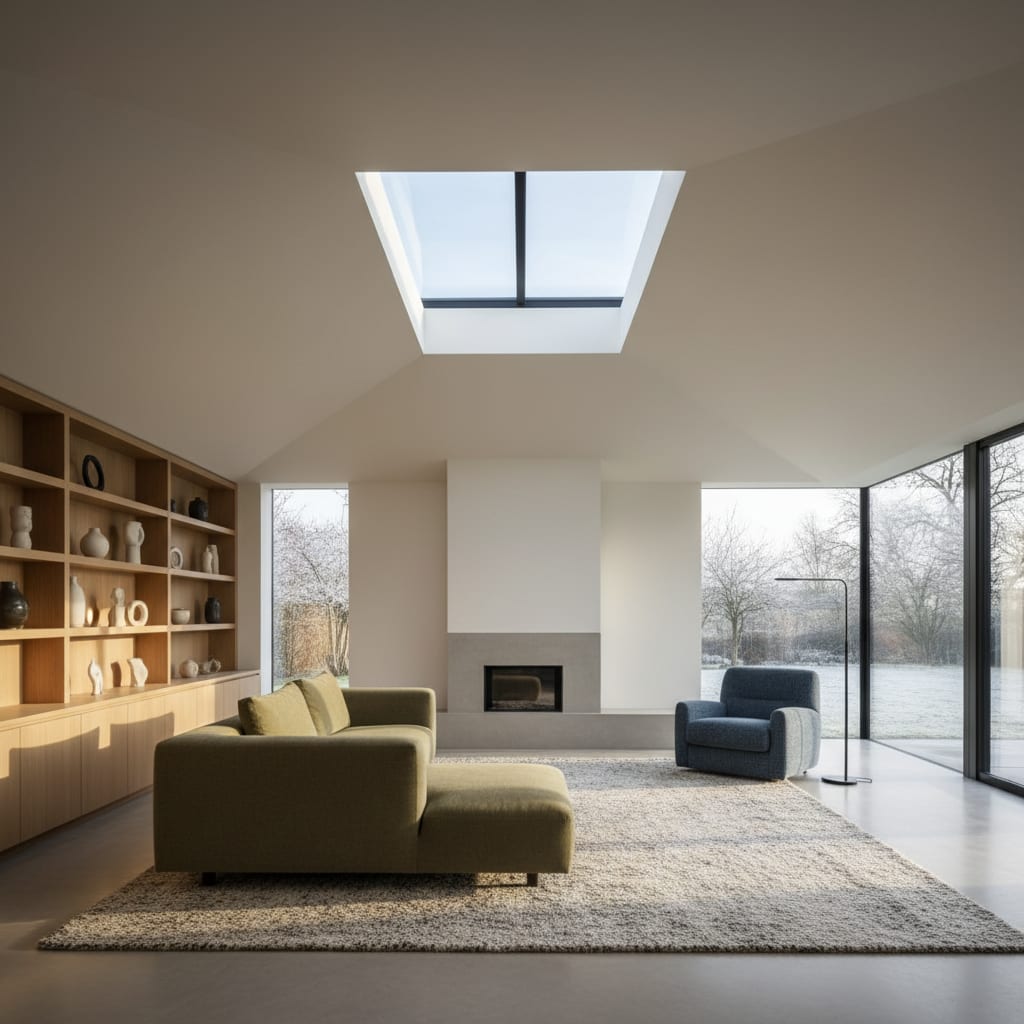
The g-value, sometimes called the solar factor or solar heat gain coefficient, is a number between 0 and 1. It tells you the proportion of solar heat that passes through the glass into the room. A g-value of 0.6 means 60% of the sun’s heat gets through; a g-value of 0.3 means only 30% does.
So for managing overheating, a lower g-value is better. The trick is reducing heat gain without dimming the room too much, and that is exactly what good solar control glass is designed to do.
How solar control glazing works
Solar control glass carries an invisible metallic-oxide coating that reflects and absorbs a portion of the sun’s infrared heat while letting visible light through. The result is a lower g-value with only a modest drop in daylight. Modern coatings are very good at this balance, which is why solar control is one of the most worthwhile upgrades for a sunny rooflight.
- Cuts heat gain: less of the sun’s warmth enters the room
- Keeps it bright: visible daylight still comes through clearly
- Reduces glare: the same coating softens harsh direct sun
- Neutral appearance: good coatings avoid a heavy tint
What counts as a good g-value for a skylight?
- Standard glazing: g-value often around 0.5–0.7, fine for shaded or north-facing roofs
- Solar control glazing: g-value typically around 0.3–0.5, a strong choice for sunny roofs
- High-performance solar control: g-value below 0.3, for large south-facing glazing
The right figure depends on how your roof faces and how much glass you are putting in. A small north-facing rooflight rarely needs aggressive solar control; a large south-facing lantern usually does.
How the coating achieves a low g-value
Solar control works by being selective about which parts of the sun’s energy it lets through. Sunlight arrives as a mix of visible light, which we see and want, and near-infrared, which we cannot see but which carries a large share of the heat. A good solar control coating is engineered to pass a high proportion of the visible light while reflecting and absorbing much of the near-infrared. That selectivity is the whole trick: it is what lets a unit keep a bright, daylit feel while cutting heat gain substantially.
The coating itself is usually a stack of microscopically thin layers, often including silver, deposited onto the glass surface facing the cavity so it is sealed and protected. Because the same coating family can also provide the low-emissivity effect that lowers the U-value, a single modern unit frequently delivers both solar control and good heat retention at once. There is, however, always a small cost in light transmittance: pushing the g-value very low tends to trim daylight a little, which is the trade-off to weigh on shaded or north-facing roofs where heat gain is not the problem.
Light-to-solar-gain ratio: the number behind the balance
The figure that captures how cleverly a glass balances daylight against heat is the light-to-solar-gain ratio, sometimes called selectivity. It is simply the light transmittance divided by the g-value. A higher ratio means more daylight for each unit of heat admitted, which is exactly what you want from solar control glass. A basic tinted glass can cut heat but dims the room badly, giving a poor ratio; a good modern solar-control coating cuts heat while keeping the room bright, giving a high ratio. When two units have a similar g-value, the one with the higher light transmittance is generally the better-engineered glass, and it is worth asking for both numbers rather than the g-value alone.
Solar control vs simple tinting

It is easy to confuse solar control glass with old-fashioned body-tinted or bronze glass. They are not the same. Tinted glass darkens the whole pane and absorbs heat across the spectrum, so it dims the room and can itself become hot, re-radiating some of that heat inward. A modern solar control coating is far more selective, rejecting infrared while passing visible light, so it stays comparatively neutral in appearance and does not leave the room gloomy. On a rooflight, where you usually want both brightness and heat control, the coated approach is almost always the right one.
Balancing g-value with daylight and U-value
Glazing is always a balance. Push the g-value very low and you may lose a little daylight; choose a unit purely for daylight and a sunny room may overheat. The aim is a specification that keeps the room bright, comfortable and warm in winter all at once.
On most sunny rooms, a solar-control double-glazed unit hits that balance better than any single-factor choice. It keeps a good U-value for winter warmth while bringing the g-value down for summer comfort. Our energy-efficient skylight installation page sets out how these numbers work together, and our triple-glazed rooflight installation page covers how a third pane affects both figures.
When solar control glazing is worth it
Often worth it
- South or west-facing roofs that catch sun for hours
- Large glazed areas such as lanterns or runs of rooflights
- Kitchens, dining rooms and home offices used through the day
- Rooms that already felt hot under an older skylight
Often less critical
- North-facing roofs with little direct sun
- Small, occasional-use spaces
- Heavily shaded positions
Solar control glass vs blinds
Blinds block heat after it has entered the room, and you have to remember to use them. Solar control glass works permanently and silently, cutting heat at the glass before it gets in. The two can work together, but on a sunny roof the glazing should do the heavy lifting, with blinds for privacy or full blackout where wanted.
Getting the specification right
The best g-value for your skylight depends on orientation, glazed area and how the room is used, balanced against the U-value for winter comfort. We assess all of that at a free survey, recommend a specification, and set it out in a fixed written quote. Every installation carries our written guarantee on our workmanship.
To talk through the right glass for your roof, get a quote for a free survey, or see our full range on the services page.
From quote to daylight, with no surprises
Fixed quote
A clear, fixed written price — online or by phone.
Survey
A specialist confirms the right glazing spec. Flexible times.
Install
Clean, weather-tight fitting that protects your property.
Guarantee
We tidy up and back the work with a written guarantee.
Frequently asked questions
What is a g-value on a skylight?
The g-value, or solar factor, is a number between 0 and 1 that measures how much of the sun’s heat passes through the glass. A g-value of 0.4 means 40% of solar heat gets through. For overheating, lower is better.
Is a high or low g-value better?
For managing overheating, a lower g-value is better because less of the sun’s heat enters the room. On shaded or north-facing roofs a higher g-value is fine, and can even help with free winter warmth.
Does solar control glass make a skylight dark?
No. Good solar control coatings cut heat gain while letting visible daylight through, so the drop in brightness is modest. The room stays bright while feeling noticeably cooler in summer.
Do I need solar control glazing for my skylight?
It is most worthwhile on south or west-facing roofs, large glazed areas, and rooms used through the day. North-facing or shaded positions often do not need it. We advise on your roof at survey.
Is solar control glass better than blinds?
Solar control glass cuts heat at the glass permanently, while blinds block heat after it enters and rely on you using them. On sunny roofs the glazing should do the main work, with blinds added for privacy or blackout.
Helpful reading on this
Costs, comparisons and answers to the questions we’re asked most.
Other skylight services
Ready to bring the daylight in?
Tell us about your project and we’ll send a clear, fixed written quote — no pressure, no surprises.
- Fixed written price before any work starts
- No pressure, no obligation, no sales calls
- Flexible survey times that suit you
- A reply within one working day