Flat Roof Skylight Installation in Cheltenham & Gloucestershire
Specialist flat-roof skylight and rooflight installation across Cheltenham, Gloucestershire and the Cotswolds — sleek glass, sound weatherproofing and a finish that fills the room with sky.
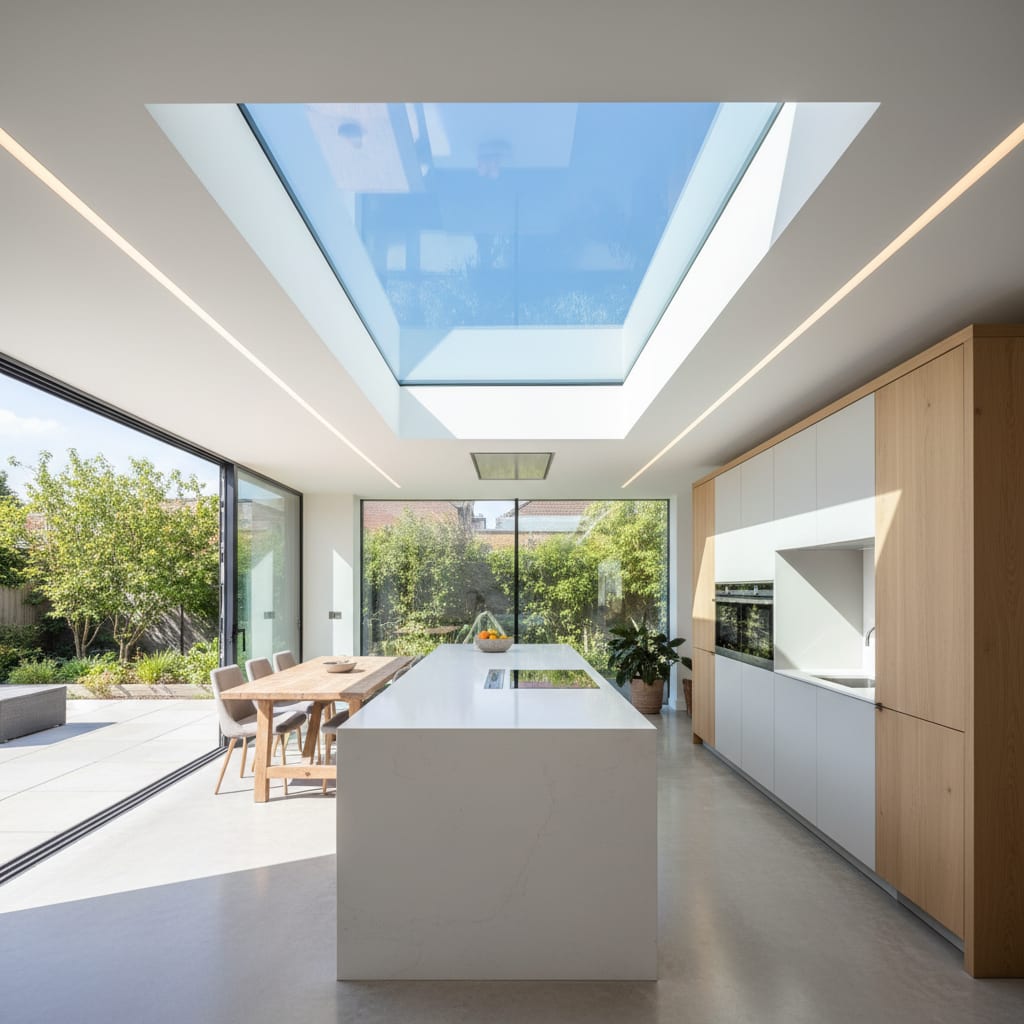
A flat-roof skylight is the cleanest, most contemporary way to bring daylight into a single-storey extension. Sitting low on the roof, a frameless or slim-framed pane of glass pours light straight down into the room and gives an uninterrupted view of the sky — without rising into the bold, architectural shape of a lantern. At Aspect Skylights Cheltenham we are skylight and rooflight specialists serving the whole of Gloucestershire, and flat-roof installations are at the heart of what we do. We fit new skylights and carry out full replacements on extensions, kitchens, flat-roof sections and commercial premises right across Cheltenham, the Cotswolds and beyond.
This page covers what a flat-roof skylight is, why this kind of work genuinely benefits from a specialist, the options open to you, how the glazing controls light and heat, what the installation involves, where building regulations and planning come in, and what you can expect to pay. Flat-roof skylights live or die on their drainage and weatherproofing detailing — which is exactly where focused experience pays off through a Gloucestershire winter.
What is a flat-roof skylight?

A flat-roof skylight — often called a flat rooflight — is a glazed unit designed to sit on a flat or very low-pitch roof. Rather than rising into a pitched shape, it lies almost level with the roof, mounted on a kerb (upstand) that lifts it just clear of the surface so water drains away. The result is a sleek, near-frameless panel of glass that reads as part of the roof rather than an object on top of it.
Flat-roof skylights are the natural choice for modern extensions, open-plan kitchens and minimalist interiors where you want maximum daylight with minimum fuss. They give a calm, even wash of light and a clear view straight up, and because they sit low they are discreet from outside. If you are deciding between this understated look and the statement of a raised lantern, our guide to roof lantern vs flat rooflight weighs the two up.
Why use a flat-roof skylight specialist

The challenge with any flat-roof glazing is water. A flat roof has no pitch to shed rain the way a tiled slope does, so it relies entirely on careful detailing — the kerb height, the fall, the flashing and the seal against your roof covering — to stay watertight. Done well, a flat-roof skylight is bone dry for decades. Done casually, it is the classic source of a slow leak. This is the single best reason to use a specialist: we detail flat-roof weatherproofing day in, day out, and we know how to marry the skylight to felt, EPDM, GRP or single-ply roofs cleanly.
Because we focus only on skylights and rooflights, we also know how each product behaves, how to set a large pane dead level, and how to handle the heavy structural glass that big single rooflights involve. We survey the actual roof, give honest advice with an architect’s eye, and quote a fixed written price. And as a Cheltenham-based team we understand local building stock — the flat-roofed rear extensions common on Gloucestershire homes, and the sensitivities of working on properties in the county’s many conservation areas.
Types of flat-roof skylight

Flat roofs can take several kinds of skylight, and the right one depends on the room, the look you want and the budget.
Flat glass rooflights
The contemporary favourite: a large, slim-framed or frameless pane of glass giving a clean, modern, near-frameless finish and a clear view of the sky. Ideal for kitchens, living spaces and modern extensions. See our fixed rooflight installation page for the daylight-only version.
Opening and ventilating rooflights
Where you need fresh air as well as light — a kitchen or a room that gets stuffy — an opening rooflight releases rising heat and steam. Manual, electric or solar operation is available, with rain sensors on the powered versions. Our opening and ventilating rooflight installation page covers this.
Dome rooflights
A practical, economical, hard-wearing option in polycarbonate or glass, with a curved profile that sheds water naturally and diffuses light softly. Excellent for utility areas, garages, outbuildings and commercial buildings — see our dome rooflight installation page.
Walk-on glass rooflights
Structural glass strong enough to walk on, used where a rooflight doubles as floor — a terrace above, or a basement lightwell below. These need specialist glazing and fixing, which is exactly our territory: see walk-on glass rooflight installation.
Frame materials

Most contemporary flat-roof skylights use slim aluminium frames, and for good reason: aluminium is strong enough to keep the frame minimal while carrying large, heavy panes, it will not rot or rust, and it needs little maintenance beyond a clean. Powder-coating lets you match almost any colour, inside and out. The aim with a flat glass rooflight is to see as much sky and as little frame as possible, and aluminium delivers that best.
Dome rooflights are typically framed in uPVC or aluminium with a polycarbonate or acrylic dome. uPVC keeps costs down and is low-maintenance, though its frames are bulkier. Timber is rarely used for flat-roof skylights, as the contemporary, minimal look that suits flat roofs sits more naturally with aluminium. We will recommend the right frame for the product and the setting at survey.
Glazing: light, heat and Part L

On a flat roof the glass faces almost straight up, so it catches a lot of sky — wonderful for daylight, but it makes solar gain and heat loss worth thinking about. The glazing is where most of the comfort comes from.
Skylights come double glazed as standard, which is the sensible baseline for most rooms. Triple glazing adds insulation and dampens rain noise on the glass — a worthwhile upgrade on very large rooflights or year-round living spaces. For a south-facing or sunny room, the most valuable specification is usually a solar-control coating, which reflects away much of the heat while keeping the room bright; it tackles overheating far more effectively than simply adding panes. A self-cleaning coating is also worth having on a flat rooflight, since rain alone keeps the out-of-reach glass clearer.
The glazing must meet the thermal requirements of Part L of the Building Regulations, which sets a maximum U-value for the unit. Quality rooflight systems are built to comply, and we specify glazing that meets the current standard as a matter of course. We will talk through light versus heat for your room and recommend the glass that suits it — not just the priciest option on the shelf.
The installation process

A flat-roof skylight installation is all about getting the kerb and the weatherproofing right. Here is how ours run.
1. Free survey and fixed quote
We measure the opening, inspect the flat-roof structure and covering, and discuss the product, glazing and operation you want. You receive a fixed written quote — the real number after seeing the job.
2. Forming the kerb
The skylight sits on a kerb that raises it clear of the roof so water drains around it. If your builder has formed an accurate, level kerb we can build straight off it; if not, we form one to the correct height and detail for your roof covering.
3. Setting the glazing
We set the rooflight dead level on the kerb and fix it securely. With large single panes, careful handling and a true, level seating are what keep the seals sound and the glass safe.
4. Weatherproofing and finishing
We dress the flashing and seals into your roof covering — felt, EPDM, GRP or single-ply — make good the internal reveal, and check the whole assembly is clean and watertight. We leave the site tidy and walk you through the result.
Most single flat-roof skylight installations are done within a day or two once the opening is ready, depending on size and access. If you are replacing an existing rooflight rather than fitting a new one, the process is similar, with attention paid to the condition of the kerb and surrounding roof.
Building regulations and planning

Most flat-roof skylight installations fall under permitted development, but the conditions matter — especially in a county as rich in conservation areas as Gloucestershire.
Permitted development and the 150mm rule
Under permitted development, a rooflight generally must not project more than 150mm above the existing roof plane, and must not sit above the highest part of the roof. A low-profile flat rooflight sits comfortably within this. If your home has already been extended, some permitted development rights may have been used.
Conservation areas and listed buildings
This is a real consideration locally. Central Cheltenham has extensive conservation areas, and the Cotswold villages around Stroud, Cirencester, Tewkesbury and Winchcombe contain many conservation designations and listed buildings. In these settings, rights can be restricted, and a rooflight visible from the street may need consent; listed buildings usually require listed building consent. The advantage of a flat rooflight here is that its low profile is often far less conspicuous than a raised lantern — sometimes making consent easier to obtain. We will advise at survey whether you need to check with the council.
Part L and Part K
Part L sets the thermal standard for the glazing’s U-value, and Part K covers safety glazing where there is a risk of falling — particularly relevant to walk-on glass, which must be rated to carry load. We specify to both as standard. You do not need to wrestle with the detail; we make sure the installation meets it.
Indicative cost of flat-roof skylight installation

Cost depends on the size and type of skylight, the glazing, the operation (fixed or opening), the roof covering and access. As an indicative 2026 guide, a quality flat glass rooflight supplied and fitted often falls in the region of £1,200 to £3,500, with very large structural panes, opening mechanisms or walk-on glass running higher, and simple domes coming in lower. A flat rooflight is generally a little more economical than a comparable lantern.
These are starting figures only. The real price is a fixed written quote after a free survey, because the roof, the opening and the specification all affect it. For more detail see our pages on flat roof skylight cost and, for the question that worries most homeowners, do skylights leak — the honest answer being that a well-detailed flat-roof skylight should not.
Flat-roof skylight installation across Cheltenham & Gloucestershire
We install flat-roof skylights throughout the county. In Cheltenham we work on flat-roofed rear extensions, modern kitchen extensions and contemporary builds across Leckhampton, Charlton Kings, Prestbury, Up Hatherley and the town centre. Across Gloucestershire we cover Gloucester, Cirencester, Tewkesbury, Stroud, Bishop’s Cleeve and Winchcombe, along with the surrounding Cotswold villages.
Flat rooflights suit the county’s many single-storey extensions particularly well, and their discreet profile is often the easier option on properties in conservation areas — common across central Cheltenham and the Cotswolds — where a raised feature might draw objection. We match the product and glazing to the room and the setting, whether that is a sleek glass rooflight over a Bishop’s Cleeve kitchen or a robust dome over a workshop near Stroud. See our areas we cover page for more.
Why choose Aspect Skylights Cheltenham
Flat-roof skylights are unforgiving of poor detailing, which is exactly why a specialist matters. Because we install rooflights all the time, our kerb forming, weatherproofing and glazing are done to a high, repeatable standard — the work that keeps a skylight dry through every Gloucestershire winter. We fit new skylights and carry out full replacements for homes and commercial premises across Cheltenham, the Cotswolds and the wider county. Every job comes with a free survey, a fixed written quote and our written guarantee on our workmanship.
We will give you honest, architect’s-eye advice on the right product, glazing and operation for your room — no hype, no unnecessary upselling. To see the full range, visit our services overview, and when you are ready, get a quote for a fixed written price after a free survey.
From quote to daylight, with no surprises
Fixed quote
A clear, fixed written price — online or by phone.
Survey
A specialist confirms the right glazing spec. Flexible times.
Install
Clean, weather-tight fitting that protects your property.
Guarantee
We tidy up and back the work with a written guarantee.
Frequently asked questions
Do flat-roof skylights leak?
A well-detailed flat-roof skylight should not leak. Flat roofs rely on correct kerb height, fall, flashing and sealing against the roof covering to stay watertight, which is precisely what specialist installation gets right. Most leaks come from poor detailing rather than the skylight itself. See our do skylights leak page for more.
How much does a flat-roof skylight cost in Gloucestershire?
As an indicative 2026 guide, a quality flat glass rooflight supplied and fitted often falls in the region of £1,200 to £3,500, with very large panes, opening mechanisms or walk-on glass running higher and simple domes lower. The real price is a fixed written quote after a free survey.
What is the difference between a flat rooflight and a roof lantern?
A flat rooflight sits low and level on the roof for a sleek, near-frameless, discreet look, while a roof lantern rises into a pitched shape as a bold architectural feature. Flat rooflights suit modern, minimalist spaces; lanterns make a statement. Our roof lantern vs flat rooflight guide compares the two.
Can I have an opening flat-roof skylight for ventilation?
Yes. Opening rooflights release rising heat and steam and bring in fresh air, ideal for kitchens and stuffy rooms. They come with manual, electric or solar operation, and powered versions can include rain sensors that close automatically. We match the operation to each room at survey.
Will a flat-roof skylight overheat my room?
It need not. A solar-control glazing coating reflects much of the heat while keeping the room bright, which is the most effective way to tackle overheating in a sunny, south-facing room. We recommend the right glazing for each room rather than a standard unit.
Do I need planning permission for a flat-roof skylight?
Most flat-roof skylights fall under permitted development, provided they project no more than 150mm above the roof plane and sit below the ridge. Their low profile often makes consent easier in conservation areas. In Cheltenham’s conservation areas, the Cotswolds and on listed buildings, restrictions can apply and we flag this at survey.
What roof coverings can you fit a skylight to?
We detail flat-roof skylights to suit felt, EPDM, GRP and single-ply roof coverings, dressing the flashing and seals cleanly into each. Getting this junction right for your specific covering is central to keeping the skylight watertight, and is part of what we do as specialists.
Can you fit walk-on glass over a basement or terrace?
Yes. Walk-on glass rooflights use structural glass strong enough to take foot traffic, used where a rooflight doubles as floor for a terrace above or a lightwell below. These need specialist glazing and fixing, which is exactly the kind of work we specialise in. See our walk-on glass rooflight page.
Helpful reading on this
Costs, comparisons and answers to the questions we’re asked most.
Common questions about flat roof skylight installation
Flat Roof Skylight Installation across Gloucestershire
Local flat roof skylight installation pages for the towns we cover most.
Other skylight services
Ready to bring the daylight in?
Tell us about your project and we’ll send a clear, fixed written quote — no pressure, no surprises.
- Fixed written price before any work starts
- No pressure, no obligation, no sales calls
- Flexible survey times that suit you
- A reply within one working day